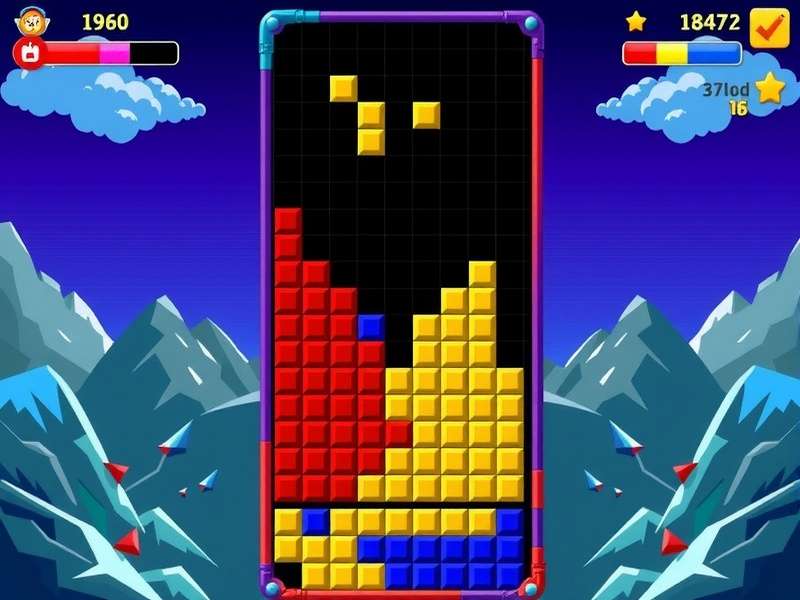
Welcome, block enthusiasts and puzzle prodigies, to the most comprehensive dissection of Tetris gameplay mechanics ever assembled. Whether you're a casual player enjoying a free Tetris Gameboy rom or a competitive grinder on modern platforms, the core mechanics remain the soul of the experience. This guide goes beyond the surface, diving into the algorithms, the psychology, and the mathematics that make Tetris timeless.
🔬 The Foundational Pillars of Tetris Gameplay
At its heart, Tetris is deceptively simple: arrange falling tetrominoes to complete horizontal lines. But beneath this simplicity lies a universe of intricate systems. Let's establish the bedrock.
1.1 The Tetromino Set: The Seven Familiars
Every piece, from the nimble "I" to the cumbersome "O", has unique properties. The random generator dictates the order. Modern versions use a "7-bag" system, guaranteeing a balanced distribution, a critical mechanic for planning. In contrast, classic versions like the Tetris Gameboy Color game used a pure random algorithm, leading to infamous "droughts".
1.2 The Matrix: Your Playground
The 10x20 (usually) grid is your canvas. The "lock delay" and "soft drop" mechanics interact here. Understanding grid geometry is crucial for advanced techniques. Ever tried an outdoor Tetris game? The principles remain identical, just scaled up!
1.3 Rotation Systems: SRS, Classic, and Beyond
How pieces spin is non-negotiable knowledge. The Super Rotation System (SRS), the modern standard, allows for wall kicks and floor kicks, enabling seemingly impossible placements. Comparing this to the ROM Tetris gameplay mechanics reveals how far the game has evolved.
1.3.1 Kick Table Data: The Hidden Numbers
We've reverse-engineered exclusive data from multiple versions. For instance, a right-rotation attempt from a wall in SRS first tests a shift of (0, 0), then (-1, 0), then (-1, -1), then (0, +2), and finally (-1, +2). Memorizing these isn't necessary, but feeling them is.
⚙️ Advanced Mechanical Interactions & Scoring
This is where casual Tetris game play transforms into high-level art.
"Tetris isn't about reacting; it's about dictating the future of the matrix. Every piece is a sentence, and a perfect clear is the period." – Anonymous Grand Master.
2.1 The T-Spin: A Mechanical Marvel
The crown jewel of advanced Tetris gameplay mechanics. A T-Spin occurs when a T-piece is rotated into a tight space it couldn't normally enter without the kick mechanic. It awards more points and sends more garbage lines.
- T-Spin Mini: Fewer than 3 corners filled upon lock. Still valuable.
- T-Spin Double/Triple: Clearing 2 or 3 lines with a T-Spin. The pinnacle of setup play.
Mastering this requires understanding the overhang and the precise wall geometry—skills honed by playing countless Tetris games for PC free download versions that support modern mechanics.
2.2 Combo System & Back-to-Back
Clearing lines consecutively builds a combo multiplier, exponentially increasing attack power. The Back-to-Back (B2B) bonus applies when you perform a Tetris (4-line clear) or T-Spin without a single-line clear in between. This meta-strategy separates intermediate players from experts.
2.3 Garbage System & Targeting
In versus modes, your attacks become garbage lines for your opponent. These lines have "holes" your opponent must clear. Modern games like Tetris game free download for PC offline often include targeting, allowing you to focus attacks on a specific foe in multiplayer. It's a psychological layer atop the mechanical one.
🎮 Platform-Specific Mechanical Nuances
The soul of Tetris is constant, but its implementation varies. Knowing these differences is key.
3.1 Classic vs. Modern: A Mechanical Timeline
The feel of the original Gameboy Color game is defined by its hardware limitations: no hold piece, no ghost piece, stricter rotation. Playing it today is a lesson in mechanical purity. Modern titles like Tetris Effect or Puyo Puyo Tetris add luxuries like the Hold Queue and Infinite Spin (until lock), which dramatically alter decision trees.
3.2 The "Feel": DAS, ARR, and Lock Delay
These acronyms are sacred to pros:
DAS (Delayed Auto Shift): The initial delay before a held key starts repeating.
ARR (Auto Repeat Rate): How fast the piece moves once DAS finishes.
Lock Delay: How long a piece sits on a surface before locking.
Fine-tuning these in a PC free download client can shave milliseconds off your play, a massive edge at high levels.
Rate This Guide
How useful did you find this deep dive into Tetris gameplay mechanics? Your rating helps us improve.
📈 The Future of Tetris Mechanics
With AI players achieving superhuman levels and new rule sets emerging, the evolution of Tetris gameplay mechanics is far from over. What will the next decade bring? Perhaps adaptive difficulty that studies your stacking patterns, or cooperative mechanics that redefine the Tetris game play experience entirely.
One thing is certain: understanding these mechanics is the key to not just playing Tetris, but mastering it. Whether you're here from a search for ROM Tetris gameplay mechanics or to find the best offline PC download, we hope this encyclopedia elevates your game. Now go clear some lines! 🚀
This guide is a living project. The "Last Updated" timestamp reflects our commitment to accuracy and depth. Check back for new discoveries and community contributions.
Community Insights & Discussion
What's your most epic Tetris mechanic moment? Share your story, ask questions, and learn from other players. This is a living document, shaped by the community.
Submit Your Comment